


NEWS
SCROLL DOWN
2022/09/30The Third Circular Economy Award is released. Industry, government and academia jointly call for: Reduce resource consumption and improve usage efficiency
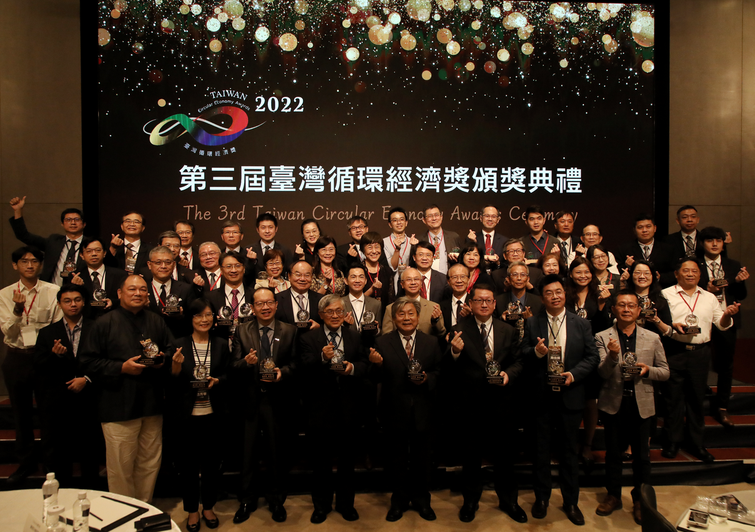
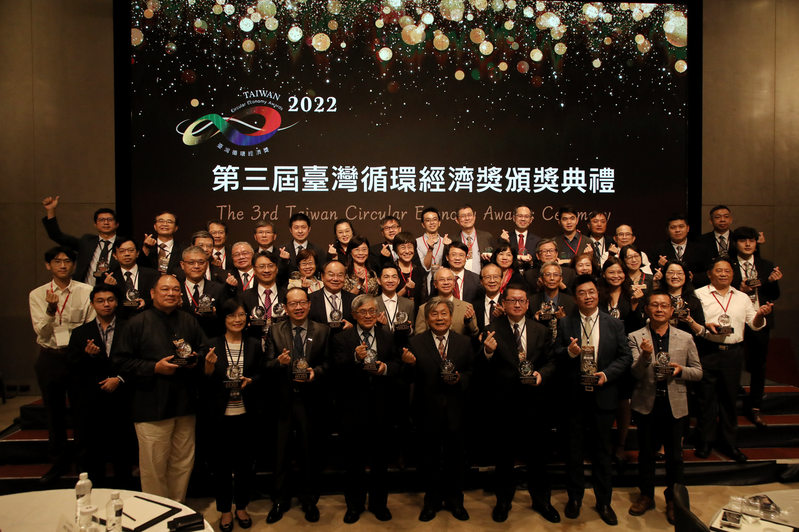
In order to commend outstanding enterprises that take into account environmental sustainability and economic
development, the Chinese Academy of Economics said goodbye to the haze of the epidemic and held the third Taiwan Circular Economy Award. Reporter Xu Shikai/Photography
The China Economic Research Institute held the third "Taiwan Circular Economy Award" award ceremony today. More than 20 judges from industry, government, and academia comprehensively took stock of the products, production methods, economic and environmental benefits of participating companies, and finally selected local companies that have invested resources sustainably in reducing carbon emissions and have achieved tangible results. These include small and medium-sized enterprises such as Hong En Plastic, which promotes plastic recycling, and PepsiCo, which uses rental services to reduce electronic waste. Major manufacturers such as AU Optronics and Taiwan Sugar have won many awards.
"Moving toward net-zero carbon emissions is not easy, but it is a big thing that if you don't do it today, you will regret it tomorrow." Zhang Chuanzhang, president of the China Academy of Economics, emphasized that as a national think tank, the China Economics Academy is bound to be responsible for Taiwan's 2050 net-zero goal. This award is to commend manufacturers with both ideals and pragmatism, and to encourage more companies to join the ranks of sustainability.
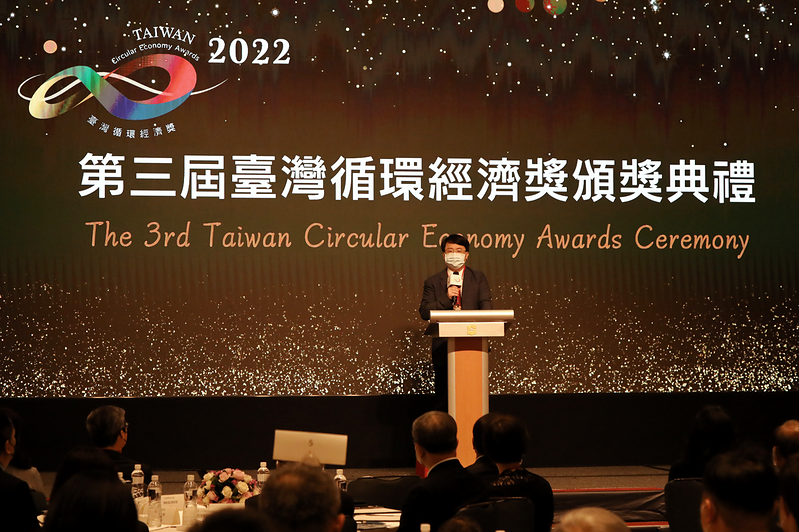
Zhang Chuanzhang, president of the China Academy of Economics, said that net-zero carbon emissions are Taiwan’s
national plan and the Circular Economy Award will resume being held every year in the future. Reporter Xu Shikai/Photography
The Taiwan Circular Economy Award has been suspended for nearly two years due to the epidemic. This grand relaunch has been divided into seven categories based on scale and industry: "Enterprise Award", "Small and Medium Enterprise Award", "Product Award", "Innovative Technology Award", "Innovative Service Award", and "Sustainability Classification Standard Special Award". All winners must pass on-site inspections by certification agencies BSI, UL, and SGS. The newly established "Hero Award" this year is based on the business philosophy and achievements of entrepreneurs. It was won by Liu Xingpeng, chairman of the green building materials manufacturer "Taijie Precision", and Yang Qingshan, chairman of "Jingguan Biotechnology", which develops low-carbon agricultural, fishery and livestock production and agricultural and food waste recycling.
Shi Junji, chairman of Taiwan Jinlian Asset Management Company and former vice president of the Executive Yuan, took stock that "increasing renewable energy and improving energy efficiency" is the only way to achieve net zero, and it is also Taiwan's top priority in facing the global competition to reduce carbon emissions. Shi Junji said that the three aspects of "sharing, repairing and renovation" of the circular economy can effectively reduce resource loss. He cited a World Economic Forum (WEF) report: When high-carbon-emitting industries adopt recycling strategies, 40 to 70% of carbon emissions can be curbed.
"In the past, resource use was a one-way model, which could never be returned and was consumed in large quantities." Shi Junji pointed out that Taiwan's resources are limited. If we want to maintain business competitiveness and avoid resource shortages, "we must establish a circular economy from now on." Shi Junji believes that when enterprises at all levels strive to renovate their production models and develop low-consumption, exclusive technologies, they will not only catch up with the international green transformation trend, but will even create another wave of economic growth.
Take the award-winning company PepsiCo as an example. PepsiCo was formerly the after-sales maintenance service department of the hardware giant Gigabyte. Now it is independent from Gigabyte and has designed "recycling" and "rental" services to reduce the electronic waste generated when people replace 3C products. Another award-winning company, Transcene, collects some of the leftover materials from semiconductor packaging, cleans them, grinds them back into spherical silica powder, and sends them back to the production line as filler.
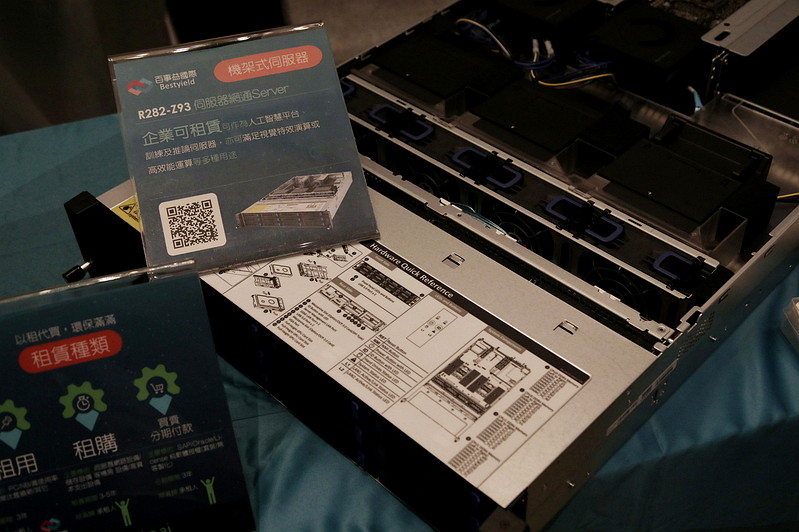
PepsiCo provides rental computer equipment to corporate customers. Reporter Xu Shikai/Photography
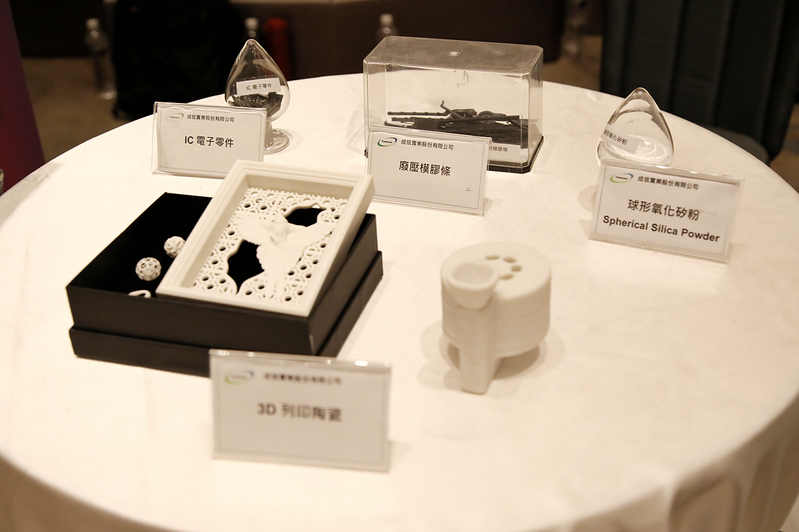
Transcene displays the remaining materials after semiconductor packaging, as well as the appearance of the raw materials
after recycling, cleaning, and regrinding. Reporter Xu Shikai/Photography
Peng Huanchen, Director of Best International Marketing and Business Department, said that they call on enterprises to rent instead of buying, and ensure that each computer can find a "suitable" user. Peng Huanchen explained that enterprises often need the fastest and latest hardware, but it is expensive and requires many products to be replaced each time. Therefore, PepsiCo cooperates with enterprises on a "long-term" basis, leasing the equipment first, then recycling it over time and passing it on to the next level of customers. It not only ensures the efficiency of equipment updating for enterprises, but also allows general users, such as schools and businesses, to enjoy computers with affordable rental prices and "very sufficient".
Shen Zhixiu, deputy director of the Environmental Protection Agency, also said that in the past, all walks of life have focused on proper waste disposal, but now they must further pursue "source reduction and reduce waste production." Shen Zhixiu said that Taiwan will generate a total of 30 million metric tons of waste in 2021, of which 62.5% of the 10 million household waste can be recycled, and 85% of the 20 million tons of industrial waste can be reused. He emphasized that proper "recycling" can eliminate waste and "let the waste materials of one industry become the raw materials of another industry."
This year's Taiwan Circular Economy Awards not only awards awards, but also cooperates with the CSRone sustainability think tank to publish the "Taiwan Enterprise Environmental External Cost Report" for the first time, analyzing to on-site companies whether the local net-zero status can be in line with international standards. In the afternoon, several award-winning units were invited to share and exchange ideas on circular economy. Including CSRone, a total of 22 units responded to this event, such as Taiwan Financial Research and Training Institute, British Standards Institution, International Climate Development Think Tank, Vision Engineering Foundation, etc.
[This article comes from - United News Network Vision Project/Reporter Xu Shikai 2022/09/30 21:03]